
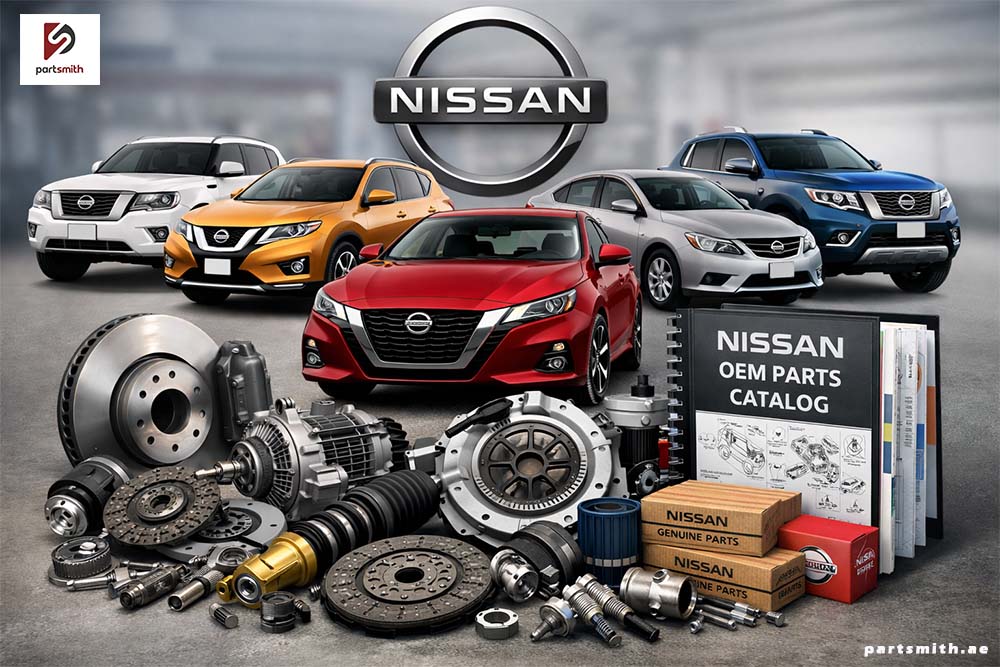
Buying the right spare parts for your Nissan vehicle is not just about replacing damaged components — it’s about ensuring safety, performance, durability, and long-term reliability. Whether you own a Nissan Altima, Sunny, Patrol, X-Trail, Navara, or any other model, using the OEM parts catalog is the most accurate and professional way to identify genuine parts.
Many vehicle owners make the mistake of relying on guesswork, mechanic suggestions, or generic aftermarket listings. This often leads to incorrect fitment, wasted money, and even mechanical failures. That’s why Nissan provides an official Nissan OEM parts catalog — a structured system that helps users identify the exact part numbers designed specifically for their vehicle.
In this detailed guide, you’ll learn how to check Nissan spare parts using the OEM catalog list step by step, even if you have no technical background. This content is designed for car owners, mechanics, workshop managers, spare parts sellers, and importers, ensuring everyone can benefit from accurate part identification.
Let’s get started.
The Nissan OEM Parts Catalog is an official database developed by Nissan that lists every genuine spare part for all Nissan vehicles worldwide. It includes:
OEM means Original Equipment Manufacturer, which means the part is made by Nissan or its authorized suppliers and matches factory-installed components exactly.
Using the OEM catalog ensures:
Unlike aftermarket catalogs, the Nissan parts catalog is structured based on VIN numbers, engine codes, chassis types, and regional production data — making it far more accurate.
Before jumping into the steps, it’s important to understand why this process matters:
1. Avoid Wrong Parts
Many Nissan models share similar names but use different components based on year, engine type, or market region.
2. Prevent Installation Issues
Incorrect parts can cause poor fitment, vibrations, leaks, or electrical faults.
3. Save Money
Returning parts costs time and money. OEM verification prevents unnecessary purchases.
4. Ensure Safety
Brake systems, suspension parts, airbags, and steering components must meet exact factory standards.
5. Maintain Vehicle Value
Using genuine Nissan spare parts helps preserve resale value and warranty coverage.
Before searching the catalog, gather the following details about your vehicle:
Having this information ready will make your search fast and accurate.
Now let’s walk through the complete process in a clear, user-friendly way.
Step 1: Locate Your Nissan VIN Number
The VIN is the most important tool for accurate parts identification.
You can find your VIN:
Example VIN format: JN1AZ34D25T123456
Each character provides manufacturing data such as:
Using the VIN ensures 100% compatibility when searching the catalog.
Step 2: Access the Nissan OEM Parts Catalog
You can access Nissan parts catalogs through:
Once inside the catalog system, you’ll typically see options to:
Always choose VIN-based search whenever possible for maximum accuracy.
Step 3: Enter Your VIN or Vehicle Details
Enter your VIN into the catalog system.
If VIN search is unavailable, manually enter:
Once entered, the system will load your vehicle’s exact build configuration — including factory-installed components.
This eliminates confusion between similar variants.
Step 4: Select the Correct Vehicle System Category
The catalog organizes parts into logical sections, such as:
For example:
If you need a brake disc, go to:
Brake System → Front Brake → Disc Rotor Assembly
Each category contains exploded diagrams that show where every component fits.
Step 5: Use the Exploded Diagram to Identify the Part
Once inside the category, you’ll see:
These diagrams are extremely useful for:
Click the part number displayed next to the diagram reference number.
Step 6: Verify the Part Description and Specifications
After clicking the part number, check:
For example:
“Front Lower Control Arm – Left Side – For 2WD Models – Production After 2018”
Always read these notes carefully to avoid mismatches.
Step 7: Check Supersession and Replacement Numbers
Sometimes Nissan updates part numbers when:
The catalog may show:
Always order the latest valid part number to ensure availability and compatibility.
Step 8: Confirm Quantity and Installation Notes
Many parts require more than one unit per vehicle (such as bolts, clips, bushings, sensors, or brake pads).
Check:
Some components require replacement of seals, gaskets, bolts, or fluids during installation — the catalog often indicates this.
Step 9: Cross-Verify with Physical Part (If Available)
If you already removed the old part:
This physical verification adds another layer of accuracy before ordering.
Step 10: Place Order Through Authorized Supplier
Once you’ve confirmed the part number:
Always ensure:
Avoid counterfeit or imitation parts that claim to be OEM without proper documentation.
Common Mistakes to Avoid When Using Nissan Parts Catalogs
Even experienced buyers sometimes make errors. Here are common mistakes to avoid:
❌ Ignoring VIN-Based Search
Manual model selection may miss hidden configuration differences.
❌ Skipping Fitment Notes
Ignoring production year breaks or engine compatibility leads to wrong purchases.
❌ Confusing Left/Right Orientation
Always check LH (left-hand) and RH (right-hand) carefully.
❌ Ordering Based on Appearance Alone
Different parts may look similar but differ internally.
❌ Using Old Part Numbers Without Checking Supersession
Always verify current valid part numbers.
Benefits of Using the Nissan OEM Parts Catalog
Using the catalog system provides several advantages:
✅ Accuracy
Parts match factory specifications exactly.
✅ Faster Repairs
Correct parts reduce delays and repeat installations.
✅ Safety Compliance
OEM parts meet crash, durability, and performance standards.
✅ Warranty Protection
Using genuine parts protects factory and extended warranties.
✅ Resale Value Preservation
Documented OEM repairs increase resale trust.
Who Should Use the Nissan OEM Parts Catalog?
This system is useful for:
Anyone involved in vehicle maintenance or repairs benefits from accurate OEM data.
How to Identify Genuine Nissan Spare Parts After Ordering
After receiving your parts, check:
If any mismatch occurs, contact the supplier immediately.
Why Nissan Uses VIN-Based Parts Identification
Nissan vehicles are produced in multiple factories worldwide, with variations depending on:
VIN-based identification ensures that your vehicle receives the exact part originally installed at the factory — not a generic substitute.
Expert Tips for Accurate Nissan Spare Parts Selection
Conclusion:
Using the Nissan OEM parts catalog list is the smartest, safest, and most professional way to identify and purchase genuine spare parts for your vehicle. Instead of guessing or relying on visual matching, this structured system ensures perfect compatibility, factory-level performance, and long-term reliability.
By following the step-by-step process outlined in this guide — from locating your VIN to verifying part numbers and confirming fitment — you can avoid costly mistakes and ensure your Nissan continues performing exactly as designed.
Whether you’re a daily driver, workshop technician, or spare parts professional, mastering the Nissan parts catalog system gives you complete control over maintenance accuracy and repair quality.
Q1: Can I use the Nissan parts catalog without VIN?
Yes, but accuracy improves significantly when using VIN-based searches.
Q2: Are OEM parts better than aftermarket parts?
OEM parts offer factory-level compatibility, durability, and safety assurance. Aftermarket parts vary widely in quality.
Q3: Can Nissan parts differ between regions?
Yes. Parts may vary between Japan, USA, Europe, Middle East, and Asian markets.
Q4: How do I know if a part number is updated?
The catalog will show superseded numbers and current replacements.
Q5: Are OEM catalogs free to access?
Some platforms offer free access, while others require subscriptions or dealer credentials.